VK

visits on art, design, architecture and literature

Category: museums/kunstverein/kunsthalle

Munich ; Pinakothek der Moderne; a Sunday afternoon visit

a lovely snowy day to visit Pinakothek der Moderne to see many masterpieces but a newly installed single channel video “Mathilde, Mathilde” caught my attention ,  by the artist I met in Berlin and  like very much,  Mathilde ter Heijne (born Strasbourg,France).

“Mathilde, Mathilde” 1999 , single screen video, 4.29 min on loop

photo & text @ artist’s published website

Mathilde is the name of the tragic heroine of Truffaut’s film La Femme d’à Côté, 1980, whose love for an older man ends in death. Also the leading female characters in Jean-Claude Briseau’s Noce Blanche, 1990, and Patrice Leconte’s Le Marie de la Coiffeuse, 1991, are named Mathilde and broken by their romantic attachments. Rather than falling victim to a disillusioning reality, the women find their escape in suicide. Mathilde ter Heijne takes these stories of self-sacrifice for an utopian ideal of love. Can fate be linked to a name? She mixes original sound extracts from the three films with video scenes in which she herself assumes the role of the tragic heroine. Using a special effects dummy, Mathilde ter Heijne depicts her death leap from the bridge and the struggle with her “alter ego.” The location for the short drama is Amsterdam where the artist used to live and work.

Munich; Friday,Jan 24, opening 19.00 hr at k.m Kunstverein München “La voix humaine”

25 January-30 March 2014

Tyler Coburn, Cecile B.Evans, R. Kelly, Kalup Linzy, Eria Scourti, Call Spooner, Frances Stark and Amelie von Wulffen

lavoixhumaine

“The group exhibition ‘La voix humaine’ at Kunstverein München features works by artists that offer contemporary perspectives on themes within Francis Poulenc’s 1958 operatic adaptation of Jean Cocteau’s one-act play of the same name. The exhibition takes this drama as its starting point to identify how heightened forms of affect are mediated in society today; from public exposure of emotionality in need of an audience to a consequential role technology plays in facilitating intimate relationships with its users”

followed by party organized by Kryselina TM with D.J DRIPPIn and M.E.S.H with performance “Damning Evidence Ilicit Behaviour Seemingly Insurmountable Great Sadness”

Munich; preview opening at Haus der Kunst: Abraham Cruzvillegas “The Autoconstrucción Suites”

25.01.2014-25.05.14

preview with the Freunde tonight of this exciting exhibition and dinner to follow

photo credit@walker art center (published photo)

“Autocontrucción” (auto-construction) is the term Abraham Cruzvillegas (born 1968) uses to describe his art, the roots of which lie in the improvised construction methods and techniques of his native Mexico City. In this exhibition, the first major survey of his artistic career to be presented in Europe, Cruzvillegas combines his dynamic sculptural language with natural materials and found objects. He thus blurs the boundaries between art and craft and between industrial and manual production. For the Mexican artist, the sculptural form is a process of change, action, solidarity, and transformation. Over the past decade, Cruzvillegas has created an impressive body of work that reflects his interest in the forms and matter surrounding Ajusco, a volcanic area south of the Mexican capital…”

The Autoconstrucción Suites” is organized by the Walker Art Center, Minneapolis, MN, USA, and presented by Haus der Kunst.

more at HdK site 

Munich; “Bernd Eichinger – …alles Kino (..Everything is Cinema) at the Kunstfoyer of VKB, Maximilianstrasse 53

29.10.2013-02.02.2014

Poster Exhibition Bernd Eichinger, Pentagram Design, Berlin

a fabulous exhibition at the Kunstfoyer der Versicherungskammer Bayern :A chronological table combined important events from his professional, private and public lives with objects, photographs and film clips.

supported by Deutche Kinemathek Museum für Film und Fernsehen

Bernd Eichinger, Los Angeles, 1980s Photo: Karin Rocholl Source: Deutsche Kinemathek – Bernd Eichinger Collection

promotion photo, WERNER BEINHART, 1991

Natja Brunckhorst CHRISTIANE F. (GDR 1981) Source: Deutsche Kinemathek

Autograph "No Fear!"Nina Hoss THE GIRL ROSEMARIE (DE 1996) Source: Deutsche Kinemathek – Bernd Eichinger Collection

@photos publishes  at Deutsche Kinemathek

Bernd Eichinger (1949–2011) was Germany’s most important film producer in recent decades. Fulfilling diverse functions, he oversaw and accepted responsibility for more than 100 film and television productions. His name is linked to the Munich distribution company “Constantin Film” where he took an active role until 2006. Initially under the name “Neue Constantin,” he led the company to major successes, building one upon the other since the 1980s.

What does a film producer do? He bears financial responsibility for a film project from beginning to end: from the development of its subject through its international marketing. He is the “driving force” behind every film production, and must know all its steps and consider any risks involved. The film producer Bernd Eichinger, who studied at the University of Television and Film Munich (HFF), embodied this role as a creative authority with all his passion; like no other. Eichinger made films for a “wide audience” beginning with his involvement with “Constantin”, although his productions often raised controversy among German critics. Within the international film business Eichinger enjoyed great recognition.”

more at Deutsche Kiemathek 

Munich; preview opening at Villa Stuck; ‘RICOCHET #8’ Jan Paul Evers

16.1.2014-23.3.2014

Museum Villa Stuck

photo: courtesy of Villa Stuck and Jan Paul Evers

curator of exhibition: Sabine Schmid

“In the exhibition series RICOCHET #8 the Museum Villa Stuck shows as the eighth position of the work by Jan Paul Evers ,born in 1982 in Cologne his first museum solo exhibition.  Jan Paul Evers follows with his works an extended term Photography: In his artistic work in the photographic process he captures space, creates it anew and finally banishes him on paper, the trace of an object is sometimes visible, other times is completely unrecognizable. Not the subject is in the center of Evers’ work, but the medium itself….”

“In his contemplative photographic works, all unique, Evers grasps  the technical and creative possibilities of the medium of photography and takes it as a starting point to examine the photograph as well as their relationship to art. It deals not only with the history and aesthetics of photography, but also with the question of authenticity, reality and perception, with ways of seeing, objectification, as well as with the technology and the design possibilities of photography….”

more at museum press release 

Munich: revisit Pinakothek der Modern, exhibition ‘Alfred Flechtheim, art dealer of the avant-garde’

24.10.2013-26.01.2014

alfredflechtheim.comAlfred Flechtheim at the Léger exhibition, Berlin 1922Photo: Atelier Lily Baruch © The Royal Library Copenhagen

The gallery owner Alfred Flechtheim (1878-1937) was a major protagonist in the art scene at the beginning of the 20th century. His commitment to the ‘Rheinische Expressionisten’ group of artists, the French avant-garde and German Modernism, and his support of great artists such as Max Beckmann, George Grosz and Paul Klee, made him internationally famous even during his lifetime. The National Socialist regime, however, changed his life and that of his family drastically. Flechtheim had to leave Germany in October 1933. As an art dealer of Jewish extraction he was publicly slandered and, by 1935, had closed his galleries in Düsseldorf and Berlin and transferred the artworks he still possessed abroad, mostly to London, where he died in 1937 at the age  of 59 as the result of an accident. His wife, Bertha, committed suicide in 1941 in the face of her imminent deportation. The remaining works of art in the flat in Berlin were confiscated.

The exceptional influence Alfred Flechtheim exerted as an art dealer representing artists defamed by the Nazis, the abrupt break in his biography and the feeling of loss this brought about, as well as the tragic fate of his family, are all reasons for this project being dedicated to his life and work.  In addition, the database generated website http://www.alfredflechteim.com provides details about the works and their respective provenance, as well as background information on 234 items now found in a total of 15 different museum collections taking part in this project.

….works by Max Beckmann, Juan Gris, Paul Klee, Karl Hofer, Ernst Barlach, at Pinakothek der Moderne may be seen with info point and iPad-terminals.

more at Pinakothek der Moderne 

and

Alfred Flechtheim site

Munich: Lenbachhaus (STÄDTISCHE GALERIE IM LENBACHHAUS UND KUNSTBAU MÜNCHEN) revisit “Gerhard Richter “Atlas Mikromega”

at Kunstbau

10.23.2013-2.9.2014

richter_micromega_presse17_quer

photo: courtesy of Lenbachhaus (published photo)

The title MICROMEGA (Greek for smalllarge) is meant to express this salient aspect of the ATLAS as a work of art. It refers to Voltaire’s “Micromégas: A Philosophical History,” a short story published in 1752 that speculates about the relative dimensions of reality.”

…In the early 1960s, Gerhard Richter starts collecting for his ATLAS thousands of photographs, newspaper clippings, sketches, and collages, which he groups based on formal criteria as well as content. He then consolidates several—sometimes dozens—of the resulting plates into blocks of imagery.

more here 

Kochel am See, Bavaria,Franz Marc Museum, “1913: Pictures before the Apocalypse”

13.10.2013-19.1.2014

1913: Pictures before the Apocalypse

“The work of Franz Marc and many of his contemporaries before World War I is marked by a foreboding of the catastrophe ahead. In retrospect, numerous indications of the impending apocalypse can be detected. From a contemporary point of view, this period was however also influenced by events that do not seem to have any connection with the war…..”

Kochelsee und Kochel am See 1.jpg

Ludwig Meidner, Straße bei Nacht II, 1913August Macke, Vor dem Hutladen, 1913

more here 

Vienna: Leopold Museum, focus on the master pieces of Egon Schiele and Gustav Klimt

Egon Schiele, Selbstporträt mit Lampionfrüchten, 1912 © Leopold Museum, Inv. 454

photos: courtesy of Leopold museum (published photos)

A lovely morning on dec 27ht to see the collection of Egon Schiele consists of 188 works on paper and 41 paintings )

see more here 

and the collection Gustav Klimt

Gustav Klimt eine seiner Katzen im Arm haltend vor seinem Atelier in Wien VIII. Josefstädter Straße 21. Photographie von Moriz Nähr um 1912. © IMAGNO/Austrian Archives

Gustav Klimt once said about himself:
“I can paint and draw. There is no self-portrait of myself. I am not interested in my own person – more in other people, females. […] I paint day by day from morning to night – figurative paintings and landscapes, less often portraits. Already when I should write a simple letter I get frightened like due to imminent seasickness. Those who want to know more about me shall observingly regard my paintings, and try to realize who I am and what I want.“

see more here

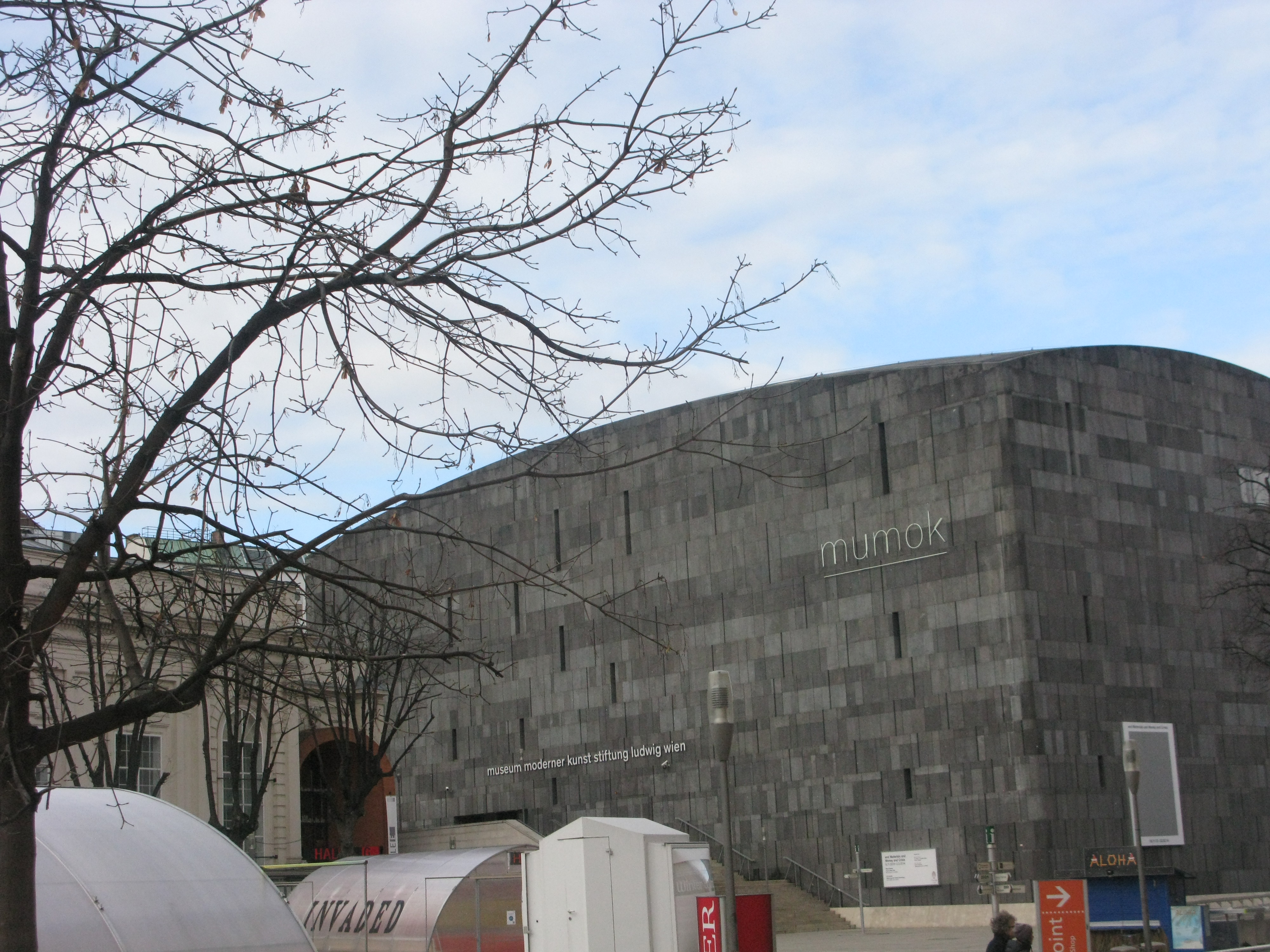
Vienna; visit Mumok, (museum moderner kunst Stiftung ludwig wien) “…and Materials and Money and Crisis”

Vienna_Mummok      IMG_3494

photos @ VK

8.11.2013-2.2.2-2014   “…and Materials and Money and Crisis” curated by New York-based curator Richard Birkett.

“…this exhibition looks toward the works of artists who conceptualize unexpected ways in which the constellation of ‘materials’, ‘money’ and ‘crisis’ hang together. The works exhibited here move beyond representational conventions, their distinctive formal and material qualities reflecting internal and external schemata of production and regulation. They work through their own material constitution to capture technical supports and organizational systems in ways that enact breakdowns and intensify internal contradictions in the idealized circulatory system of exchange. As capital flows through a financial system composed of pure media, in which the materiality of price is emancipated from any even illusory reference to physical property,  and Materials and Money and Crisis ask how aspects of materialization within art might be read as a response to crises in the process of valorization. Artist in the exhibition: Terry Atkinson, Maria Eichhorn, Melanie Gilligan, Gareth James, Sam Lewitt, Henrik Olessen, Pratchaya Phinthong, R.H.Quaytman, Lucy Raven, Cheney Thompson,Emily Wardill.

more here

Keith York City

History made interesting

VK

visits on art, design, architecture and literature

Eclectic Trends

Interior Design and Lifestyle Trends

maria sarri Art projects

#art_projects, #public_art, #site_specific, #post_colonial, #urban_art

Η καλύβα ψηλά στο βουνό

Σε κοίταζα μ' όλο το φως και το σκοτάδι που έχω

tangledjourneys

A personal perspective on human interest stories from an American journalist living abroad

An Englishman in Berlin

Blog about life and culture in Berlin, Germany

nefeliatelier

bits and pieces that interest me

A R T L▼R K

An Alternative Cultural Daybook

Venetian Red Art Blog

Art, the resplendent light that illuminates the world

The School Of Life

visits on art, design, architecture and literature

IGNANT

visits on art, design, architecture and literature

βλέμμα

visits on art, design, architecture and literature

λεξήματα

visits on art, design, architecture and literature

flaneries

This WordPress.com site is the bee's knees

βλέμμα

gaze at Greece

SOUZY TROS

the new T.A.M.A platform