VK

visits on art, design, architecture and literature

Category: visual arts

Athens; Benaki museum; opening of exhibition by Andro Wekua “pink wave hunter” (collaboration with Deste Foundation)

29.01. 2014-23.03.2014

ANDRO WEKUA&nbsp;<br/><em>PINK WAVE HUNTER</em>

A new program of collaboration between the Benaki Museum and the DESTE Foundation, opens with an exhibition of Andro Wekua.

This exhibition features  a series of sculptural models of buildings drawn from memories of Wekua’s childhood in Sukhumi, Georgia.  Wekua was born in the popular seaside town of Sukhumi, where he lived until his family was forced to flee during the Abkhazian conflict of the 1990’s.  The town was subsequently devastated by civil war, leaving the artist and his family part of the Georgian diaspora unable to return to home. Drawing on this experience, Wekua conjures images of his childhood town from memory and, supplemented by online research, creates sculptural representations of the city’s buildings. (press release ) 

curatorial decisions and exhibition lay out is done by the artist.
more on Benaki museum 

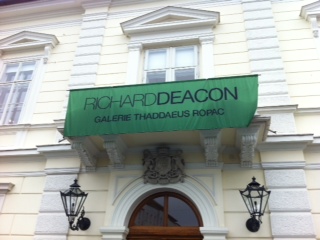
Salzburg villa Kanst _Ropac gallery; preview opening for Richard Deacon “form and colour?”

25 Jan. – 5  April, 2014

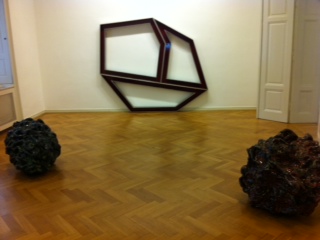
Richard Deacon ” form or color?”  (sculptures and wonderful film with the artist work); Lee Bull (sculpture and drawings) in the right wing  gallery and downstairs gallery the young french artist, much promising Claire Adelfang (photographs)

photo

photo copy 9

photo copy

“Along with Tony Cragg (b 1949) and Antony Gormley (b 1950), Richard Deacon is one of the most important contemporary British sculptors. His existential study of form and space reveals a fundamentally new approach, the determining factor being his treatment of the most diverse materials. The wavy, convoluted sculptures with their intricate rhythms and the biomorphic spatial objects are amongst the most complex works of modern sculpture.”….

“…In 1999, Richard Deacon began working with ceramics in a Cologne workshop. In Salzburg we are showing four enigmatic biomorphic sculptures of this material, multicoloured and with a gorgeous glaze.”

at the opening of the exhibition today was  presented for the first time the book Richard Deacon: So, And, If, But, ed. Dieter Schwarz (Winterthur Museum of Art), an anthology of essays on art theory by Richard Deacon, written during the years 1970-2012.

The film In Between – der Künstler Richard Deacon (Germany, 2012) by Claudia Schmid also at the exhibition.

more here 

Munich; Friday,Jan 24, opening 19.00 hr at k.m Kunstverein München “La voix humaine”

25 January-30 March 2014

Tyler Coburn, Cecile B.Evans, R. Kelly, Kalup Linzy, Eria Scourti, Call Spooner, Frances Stark and Amelie von Wulffen

lavoixhumaine

“The group exhibition ‘La voix humaine’ at Kunstverein München features works by artists that offer contemporary perspectives on themes within Francis Poulenc’s 1958 operatic adaptation of Jean Cocteau’s one-act play of the same name. The exhibition takes this drama as its starting point to identify how heightened forms of affect are mediated in society today; from public exposure of emotionality in need of an audience to a consequential role technology plays in facilitating intimate relationships with its users”

followed by party organized by Kryselina TM with D.J DRIPPIn and M.E.S.H with performance “Damning Evidence Ilicit Behaviour Seemingly Insurmountable Great Sadness”

Munich; preview opening at Haus der Kunst: Abraham Cruzvillegas “The Autoconstrucción Suites”

25.01.2014-25.05.14

preview with the Freunde tonight of this exciting exhibition and dinner to follow

photo credit@walker art center (published photo)

“Autocontrucción” (auto-construction) is the term Abraham Cruzvillegas (born 1968) uses to describe his art, the roots of which lie in the improvised construction methods and techniques of his native Mexico City. In this exhibition, the first major survey of his artistic career to be presented in Europe, Cruzvillegas combines his dynamic sculptural language with natural materials and found objects. He thus blurs the boundaries between art and craft and between industrial and manual production. For the Mexican artist, the sculptural form is a process of change, action, solidarity, and transformation. Over the past decade, Cruzvillegas has created an impressive body of work that reflects his interest in the forms and matter surrounding Ajusco, a volcanic area south of the Mexican capital…”

The Autoconstrucción Suites” is organized by the Walker Art Center, Minneapolis, MN, USA, and presented by Haus der Kunst.

more at HdK site 

Munich; Haus der kunst;revisit ‘So Much I Want to Say: From Annemiek to Mother Courage’ — Goetz Collection at Haus der Kunst

exhibition 19.04.13-12.1.14

photo: courtesy Goetz collection, Andrea Bowers, ‘Letter to an army of Three’,2005

The title of this fifth presentation of works from the Goetz Collection at Haus der Kunst is borrowed from an early video work by Mona Hatoum from 1983. It is based on the material of a performance: While Mona Hatoum’s voice repeatedly says, “So Much I Want to Say”, images depict a woman’s face being obscured by men’s hands.

… Works by female artists constitute nearly half of the pieces in Ingvild Goetz’s collection of media art. These works represent and illustrate the key stages of the feminist discourse and feminist film theory since the 1970s. With works by Chantal Akerman, Andrea Bowers, Rineke Dijkstra, Cheryl Donegan, Mona Hatoum, Lucy McKenzie & Paulina Olowska, Tracey Moffatt, Ulrike Ottinger, Ryan Trecartin, and Rosemarie Trockel.

So Much I Want to say – Goetz Collection at Haus der Kunst” is open daily from 25.12.13 thru 30.12.13 and from 01.01.14 thru 06.01.14; hours 10 am – 8 pm, Thursdays until 10 pm.

read more 

Munich: revisit Pinakothek der Modern, exhibition ‘Alfred Flechtheim, art dealer of the avant-garde’

24.10.2013-26.01.2014

alfredflechtheim.comAlfred Flechtheim at the Léger exhibition, Berlin 1922Photo: Atelier Lily Baruch © The Royal Library Copenhagen

The gallery owner Alfred Flechtheim (1878-1937) was a major protagonist in the art scene at the beginning of the 20th century. His commitment to the ‘Rheinische Expressionisten’ group of artists, the French avant-garde and German Modernism, and his support of great artists such as Max Beckmann, George Grosz and Paul Klee, made him internationally famous even during his lifetime. The National Socialist regime, however, changed his life and that of his family drastically. Flechtheim had to leave Germany in October 1933. As an art dealer of Jewish extraction he was publicly slandered and, by 1935, had closed his galleries in Düsseldorf and Berlin and transferred the artworks he still possessed abroad, mostly to London, where he died in 1937 at the age  of 59 as the result of an accident. His wife, Bertha, committed suicide in 1941 in the face of her imminent deportation. The remaining works of art in the flat in Berlin were confiscated.

The exceptional influence Alfred Flechtheim exerted as an art dealer representing artists defamed by the Nazis, the abrupt break in his biography and the feeling of loss this brought about, as well as the tragic fate of his family, are all reasons for this project being dedicated to his life and work.  In addition, the database generated website http://www.alfredflechteim.com provides details about the works and their respective provenance, as well as background information on 234 items now found in a total of 15 different museum collections taking part in this project.

….works by Max Beckmann, Juan Gris, Paul Klee, Karl Hofer, Ernst Barlach, at Pinakothek der Moderne may be seen with info point and iPad-terminals.

more at Pinakothek der Moderne 

and

Alfred Flechtheim site

Munich, revisit Villa Stuck “In the Temple of the Self The Artist’s Residence as a Total Work of Art – Europe and America 1800-1948”

21.11.2013-2.3.2014

curated by Margot Th. Brandlhuber

Museum Villa Stuck

On November 21st, the museum Villa Stuck opened _as an anniversary project – the exhibition »In the Temple of the Self: The Artist’s Residence as a Total Work of Art.« An exemplary artist’s residence, the Stuck villa is not just the supreme expression of »artist prince« Franz von Stuck’s life-as-total-work-of-art, but also his most splendid artwork. It is the culmination of his aspirations for a unification of all the arts…..

….The exhibition presents both famous existing artist’s residences and projects that, though nowadays lost, destroyed and forgotten, were uniquely important in their time and continue to exude a fascinating aura to this very day. Selected works by the artists that are closely linked to their residences, as well as photographs, drawings and models, convey vivid impressions of the blending of art and life and the harmony of the arts that is reflected in the historical term of the gesamtkunstwerk as it was understood by Richard Wagner…..”

Among the artist’s residences included are the John Soane’s Museum in London, the Red House of William Morris in Bexleyheath, the Tiffany House of Louis Comfort Tiffany in New York City, Mortimer Menpes’s residence in London, the villa of Fernand Khnopff in Brussels, Kurt Schwitters’s MERZbau in Hanover, the house of Konstantin Melnikov in Moscow, Theo van Doesburg’s maison in Meudon-Val-Fleury near Paris and the residence of Max Ernst in Sedona, Arizona.

more here 

Munich: Lenbachhaus (STÄDTISCHE GALERIE IM LENBACHHAUS UND KUNSTBAU MÜNCHEN) revisit “Gerhard Richter “Atlas Mikromega”

at Kunstbau

10.23.2013-2.9.2014

richter_micromega_presse17_quer

photo: courtesy of Lenbachhaus (published photo)

The title MICROMEGA (Greek for smalllarge) is meant to express this salient aspect of the ATLAS as a work of art. It refers to Voltaire’s “Micromégas: A Philosophical History,” a short story published in 1752 that speculates about the relative dimensions of reality.”

…In the early 1960s, Gerhard Richter starts collecting for his ATLAS thousands of photographs, newspaper clippings, sketches, and collages, which he groups based on formal criteria as well as content. He then consolidates several—sometimes dozens—of the resulting plates into blocks of imagery.

more here 

Kochel am See, Bavaria,Franz Marc Museum, “1913: Pictures before the Apocalypse”

13.10.2013-19.1.2014

1913: Pictures before the Apocalypse

“The work of Franz Marc and many of his contemporaries before World War I is marked by a foreboding of the catastrophe ahead. In retrospect, numerous indications of the impending apocalypse can be detected. From a contemporary point of view, this period was however also influenced by events that do not seem to have any connection with the war…..”

Kochelsee und Kochel am See 1.jpg

Ludwig Meidner, Straße bei Nacht II, 1913August Macke, Vor dem Hutladen, 1913

more here 

Vienna ; visit Mumok (museum moderner kunst stiftung ludwig), Marge Monko “how to wear red”

Marge Monko  “How to Wear Red” curated by Rainer Fuchs

25.10.2013-02.02.2014

At the center of Marge Monko’s (b.1976 n Tallinn-video and photo works lies an examination of  social developments in a post-socialist context.  Marge Monko is the winner of the 2012 Henkel Art Award. Monko traces the changes in gender -based role models that were inserted into Estonian culture by neoliberalism after the end of the Soviet era. In How to Wear Red she portrays a society undergoing change and refers to the connections between the communist past and present day identify models.  The artist also exhibits a similar critical awareness of communist legacy history in her photo work about the Soviet monument in Vienna’s Schwarzenberplatz.

In some of her works Marge Monko links questions of the reality of gender specific hierarchies with ethnic conflicts. One of the works that I enjoyed was the two part video work , Forum (2010) …

Here, the two subjects overlap and is especially pronounced in the form of underprivileged Russian textile workers; they have been multiply marginalized, not only as women and as part of an ethnic minority but also as symbols of a former occupier..  In this work, the title of the work refers to a television debate which took place in 2009; in it political and trade union representatives discussed a new labor law in the context of the economic crisis. In the final outcome it was the Russian women workers who suffered most. While the original discussion was carried out exclusively by men, Marge Monko has the unemployed Russian women take over their roles. They read the original statements but add their own critical commentaries. In this way those who had no opportunity to speak for themselves at the time can now make their voice heard  – a reference to Bertolt Brecht’s worker’s theater.

see more images here 

Keith York City

History made interesting

VK

visits on art, design, architecture and literature

Eclectic Trends

Interior Design and Lifestyle Trends

maria sarri Art projects

#art_projects, #public_art, #site_specific, #post_colonial, #urban_art

Η καλύβα ψηλά στο βουνό

Σε κοίταζα μ' όλο το φως και το σκοτάδι που έχω

tangledjourneys

A personal perspective on human interest stories from an American journalist living abroad

An Englishman in Berlin

Blog about life and culture in Berlin, Germany

nefeliatelier

bits and pieces that interest me

A R T L▼R K

An Alternative Cultural Daybook

Venetian Red Art Blog

Art, the resplendent light that illuminates the world

The School Of Life

visits on art, design, architecture and literature

IGNANT

visits on art, design, architecture and literature

βλέμμα

visits on art, design, architecture and literature

λεξήματα

visits on art, design, architecture and literature

flaneries

This WordPress.com site is the bee's knees

βλέμμα

gaze at Greece

SOUZY TROS

the new T.A.M.A platform